"The Rosary is a way of praying to God, simple and within the reach of everyone. It consists in the recitation of fifteen decades of Ave Marias, each one preceded by the Our Father and followed by the Gloria Patri together with the meditation of fifteen Mysteries of our holy Religion which present to us the Life, Passion and Glory of Our Lord Jesus Christ." ( Pope St. Pius V in Consueverunt Romani Pontifices, 1569)
It was Pope Saint Pius V, a Dominican Pope, who defined and gave to the Rosary the form as we know it today. Divine Providence, by both tradition and consistent Papal documents has made the sons of St. Dominic the guardians and promoters of this most salutary devotion.
Lacordaire, the greatest Dominican preacher of his day remarked:
"There is but one book - the Gospel. And the Rosary is nothing else that an abridgment of the Gospel."
"In the Rosary, contemplation is borne forward by the words of the Hail Mary and of the Lord's Prayer recurring throughout as its main theme. In this perfect blending of progressing contemplation with a recurring prayer theme lies the essence of the Rosary.
To recite the Rosary rightly demands practice, but once we are fully acquainted with it, it may become for us a quiet hidden land in which we may dwell and find peace, or a chapel whose doors are ever open and into which we can take the burdens of our souls." (Guardini, Romano, The Art of Praying, Sophia Institute Press, 1994, p.106)
Pope St. Paul VI wrote:
"As a Gospel prayer, centered on the mystery of the redemptive Incarnation, the Rosary is therefore a prayer with a clearly Christological orientation. Its most characteristic element, in fact, the litany-like succession of Hail Mary's, becomes in itself an unceasing praise of Christ, who is the ultimate object both of the Angel's announcement and of the greeting of the Mother of John the Baptist: "Blessed is the fruit of your womb" (Lk 1 :42)
" ... the Rosary is a practice of piety which easily harmonizes with the liturgy. In fact, like the liturgy, it is of a community nature, draws its inspiration from Sacred Scripture and is oriented towards the mystery of Christ. The commemoration in the liturgy and the contemplative remembrance proper to the Rosary, although existing on essentially different planes of reality, have as their object the same salvific events wrought by Christ. The former presents anew, under the veil of signs and operative in a hidden way, the great mysteries of our redemption. The latter, by means of devout contemplation, recalls these same mysteries to the mind of the person praying and stimulates the will to draw from them the norms of living." (Pope Paul VI, Apostolic Exhortation Marialis Cultus, 46, 48, 1974)
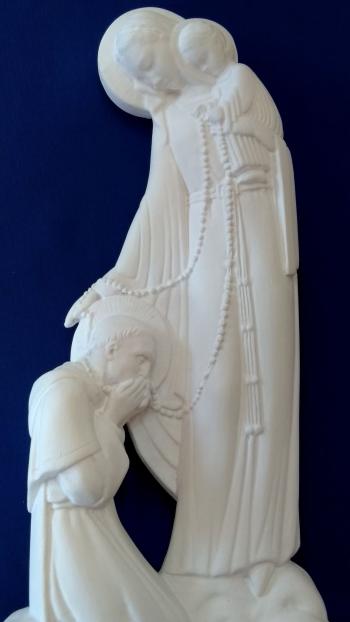
The Rosary focuses our mind and heart on the life of Christ, our Redeemer, and His Holy Mother. In this most beautiful, evangelical prayer we give praise and honour to Jesus through Mary. By meditating on the Mysteries of our faith, we grow in knowledge and love of Christ and draw closer to Him in the Sacraments. Thus, the life of the Christian grows in faith, hope and charity.
"The purpose of the Rosary was, therefore, to produce the effect that St. Dominic had in view in all his prayers, an intense application of the human soul to the divine personality of Christ." (Jarrett, Bede, O.P. The Life of St. Dominic, Blackfriars Publications, London, 1955).
"We earnestly advise everyone to say the Rosary: the virtuous, that they may persevere and grow in the grace of God; sinners, that they may rise from their sins.” (St. Louis de Montfort, Secret of the Rosary 118).
"Let the learned and the ignorant, the just and the sinners, the great and the small praise and honour Jesus and Mary night and day by saying the holy Rosary" (SR 8).
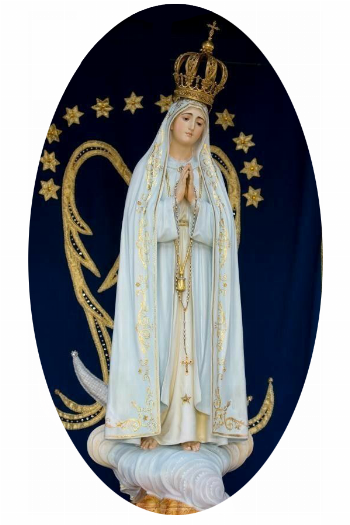
At Fatima, in 1917, the Mother of God appeared to the three little shepherd children six times. Each time she repeated the same request: "Pray the Rosary everyday for peace in the world ... "
a thought from Ven. Archbishop Fulton Sheen:
"Start praying the Rosary for thirty days. Do not answer: 'But how can I pray if I do not believe?' If you were lost in the forest, even if you had no hope in the presence of someone near by, nevertheless you would shout all the same. Well, start praying. You will be surprised. Mary will answer you. I promise."
| 1. Supremi apostolatus officio | 1 September 1883 |
| 2. Superiore anno | 30 August 1884 |
| 3. Quod auctoritate | 22 December 1885 |
| 4. Vi è ben noto | 20 September 1887 |
| 5. Octobri mense | 22 September 1891 |
| 6. Magnae Dei Matris | 8 September 1892 |
| 7. Laetitiae sanctae | 8 September 1893 |
| 8. Iucunda Semper Expectatione | 8 September 1894 |
| 9. Adiutricem populi | 5 September 1895 |
| 10.Fidentem Piumque Animum | 20 September 1896 |
| 11.Augustissimae Virginis Mariae | 12 September 1897 |
| 12.Diuturni Temporis | 5 September 1898 |
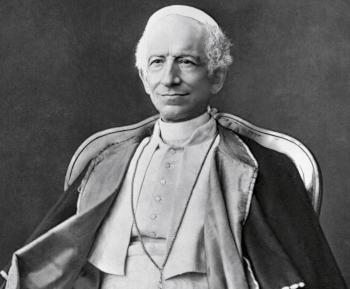
The Twelve Rosary Encyclicals of Pope Leo XIII Part 1-2-3.
The Twelve Rosary Encyclicals of Pope Leo XIII Part 4-5-6
The Twelve Rosary Encyclicals of Pope Leo XIII Part 7-8-9
The Twelve Rosary Encyclicals of Pope Leo XIII Part 10-11-12